
Why every child’s language timeline looks different
Remember those milestone charts? The ones that list exactly what your child should be doing by exactly what age, as if babies received the memo and are diligently working through it? Yes, those charts.
Here’s the thing nobody puts in big bold letters at the top: children develop language skills at their own gloriously unpredictable pace. One toddler is delivering monologues about dinosaurs at 18 months. Another is perfectly content to communicate entirely through pointing and meaningful eye contact until well past their second birthday. Both are completely normal.
Language development isn’t a race with a finish line — it’s more like a winding road where every child takes slightly different turns. It begins long before your child says their first word: those early coos, babbles, and dramatic arm-waves are already the foundations of oral language skills being laid down, brick by tiny brick.
So before you spiral into a Google rabbit hole at midnight, take a breath. Your child is developing. It’s just happening on their timeline, not the chart’s.
The stages — what’s actually happening in your child’s brain
Think of language development as a Netflix series with several seasons — each one building on the last, and just when you think you know where it’s going, your toddler throws in a plot twist.
It starts with babbling. Around 4–6 months, your baby begins experimenting with sound — single-syllable sounds like “ba” and “ma” that they’ll soon start repeating with great enthusiasm. Then comes what researchers call the jargon phase — that hilarious window where your child sounds absolutely convinced they’re telling you something incredibly important, but not a single word is recognisable. Nod along. They mean business.
Around 10–11 months, the first real word arrives. From there, vocabulary growth accelerates quickly. Here’s the part most parents find surprising: comprehension always outpaces production. Your child understands significantly more than they can say — so those instructions you thought were going over their head? Heard. Processed. Possibly filed away to repeat at the worst moment.
By 18–24 months, most toddlers begin combining two words into short sentences. By age three, they’re speaking in fuller sentences. By eight, they can hold adult-like conversations — which, fair warning, includes arguing back with complete coherence.
Each stage builds directly on the last. Miss nothing — it’s all connected
The real secret: it’s not flashcards, it’s conversation
If you’ve ever bought a set of educational flashcards, used them twice, and quietly slid them behind the sofa — no judgment. The truth is, the single most powerful tool for building your child’s language isn’t a product. It’s you, talking.
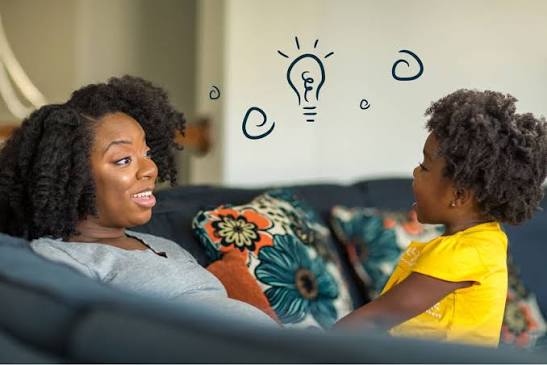
The magic happens through turn-taking — that simple back-and-forth where you say something, pause, and let your child respond. Even before they have words, responding to their gestures matters enormously. When your baby points at the dog, don’t just glance over. Say, “Yes! That’s the dog — he’s fluffy and very dramatic about mealtimes.” You’re not just labelling things; you’re building a word-rich environment one exchange at a time.
As words emerge, try sentence expansion — gently stretching what they say into something fuller. They say “juice.” You say “You want more orange juice?” No correction, no pressure. Just a natural nudge forward.
Now, here’s the part the parenting articles conveniently skip: this is genuinely hard when you’re exhausted. Nobody feels like a cheerful running commentary after a full workday. The good news is it doesn’t have to be a structured activity. Bath time, the car ride, waiting at school pickup — these small pockets of responding to gestures and conversation add up to more than any flashcard ever could.
Presence, even imperfect presence, is enough.
Reading aloud: why it works (and what most parents get wrong)
Reading aloud to your child is one of the most researched, most consistently recommended things you can do for language development. But the how matters just as much as the habit itself.
The real benefit isn’t just hearing words — it’s the conversation around the book. Pointing to words as you say them shows your child the link between spoken and written language, a foundational step toward literacy. Linking the story to real life (“the boy in this book went to the park — what do you like to do at the park?”) turns a passive moment into an active dialogue. That back-and-forth is where the real book-sharing magic happens.
Which brings us to screens. Many parents today reasonably wonder whether educational apps count. Here’s the honest answer: passive consumption — a child watching content without any interaction — does not build language the same way conversation does. A toddler can watch a vocabulary show on repeat and absorb far less than they would from ten minutes of active back-and-forth with you over a picture book. The app can’t notice your child’s confused expression. It can’t pause, rephrase, and try again. You can.
This isn’t a guilt trip about screen time — it’s a reframe. The goal isn’t to eliminate screens; it’s to make sure that active consumption and real conversation are getting enough space in the day. Even fifteen focused minutes of read-aloud time carries outsized weight.
The tablet can stay. Just make sure you’re still in the room too
Raising bilingual children: the advice nobody corrects
Let’s address something that gets whispered at family gatherings and stated with surprising confidence by people who are not, in fact, speech experts: “Speaking two languages will confuse your child.”
It won’t.
Bilingual and multilingual development is not only perfectly normal — it’s associated with richer cognitive outcomes and stronger cultural identity. Yes, your child may mix languages in the same sentence early on. This is called code-switching, and it isn’t a warning sign. It’s actually evidence that their brain is doing something remarkably sophisticated — managing two entire linguistic systems simultaneously, which is considerably harder than anything on those milestone charts.
The most important thing you can do in a multilingual household is keep going. Speak your languages with confidence and consistency. Don’t quietly drop one because a relative raised an eyebrow. Your child’s brain is more capable of handling this than the eyebrow-raiser gives it credit for.
Two languages aren’t a burden. They’re a gift with a slightly longer ribbon.
When to actually see a speech pathologist — without panicking first
Here’s the uncomfortable truth about milestone articles: they list the warning signs clearly, and then leave you alone with them at 11pm with a full search history and a rising heart rate. So let’s do this differently.
There are genuine red flags worth acting on. If your child isn’t babbling by 6 months, isn’t using gestures like pointing or waving by 12 months, hasn’t said any single words by 18 months, or isn’t combining two words by age two — those are signals worth discussing with a professional. Similarly, if your child loses a language skill they previously had, don’t wait. Language regression is always worth flagging early.
A speech pathologist isn’t a last resort. They’re a specialist you call the same way you’d call a physio for a sprained ankle — because early intervention works, and there’s nothing heroic about waiting.
Many parents also carry a quieter worry underneath all of this: will my child be ready for school? Will their teacher notice? Will they fall behind? These are valid, real concerns — and the honest answer is that catching and addressing delays early gives children the strongest possible foundation before they ever set foot in a classroom. Asking for help isn’t an admission that something is wrong. It’s the most useful thing you can do.
If your gut says something is off, trust it. You know your child better than any chart does.
You’re already doing more than you think
Remember the parent at the beginning of this post — the one quietly panicking over a milestone chart at midnight, wondering if they’d somehow failed their child by not talking enough, reading enough, doing enough?
That parent looked it up. They cared enough to search, to read, to worry in that particular way that only comes from loving someone very small and very fiercely. And here’s what that actually means: they were already paying attention. Which is, it turns out, most of the job.
Language development doesn’t require a curriculum, a subscription, or a perfectly narrated trip to the supermarket every single day. It requires connection. The small, ordinary, sometimes half-asleep moments where you respond to a point, expand a sentence, read three pages of a picture book before someone loses interest and wanders off — those moments are building something real. Brick by tiny brick, just like we said at the start.
Your child is listening. They’re absorbing more than you know, understanding more than they can say, and storing up words they’ll produce when they’re ready — possibly all at once, possibly loudly, possibly in public.
So close the milestone chart. You’re doing fine. And so are they.
Leave a Reply